Citronella vs Lemon Eucalyptus: Which Skin Shield Is Right for You?
- June 02, 2026
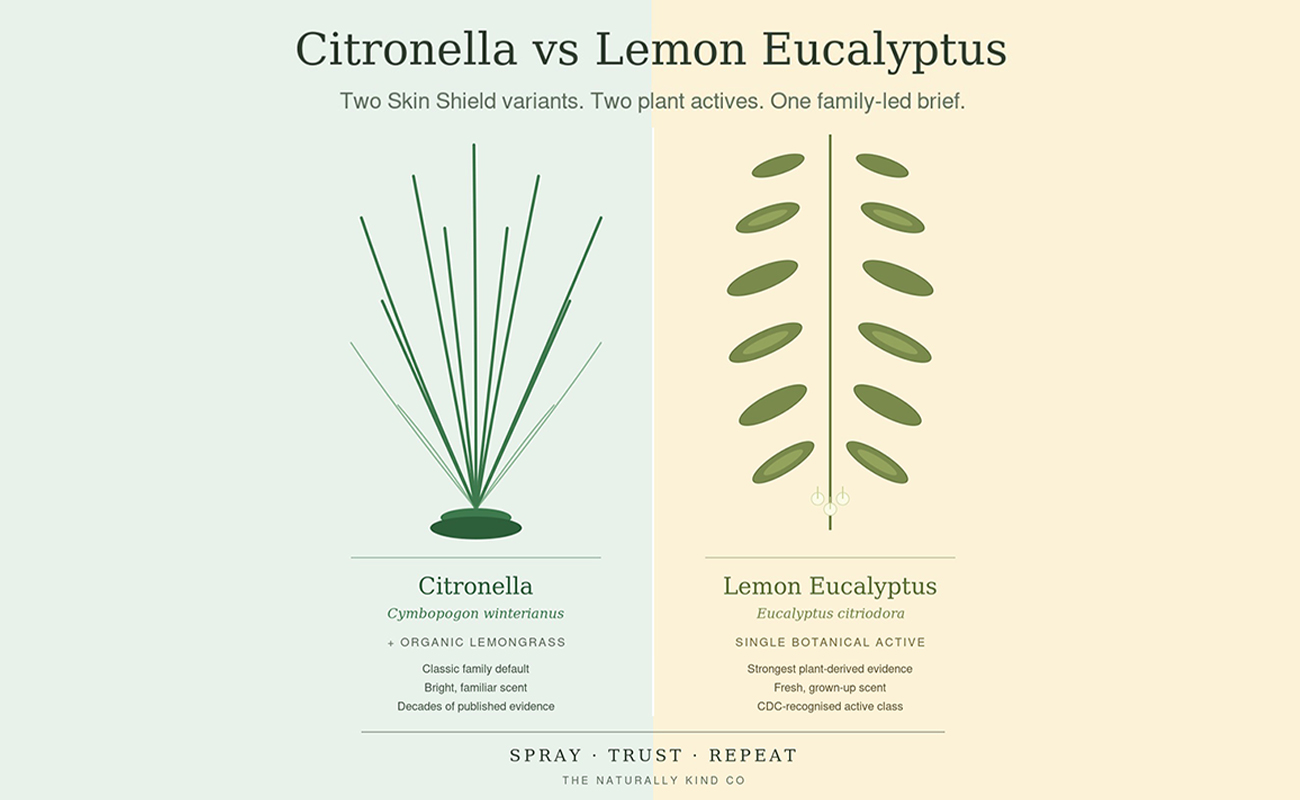
Stand in front of our shelf and you’ll see two Skin Shield bottles. Same hydrating spray, same family-led philosophy, two different plant actives doing the mosquito-repelling work. Citronella in one. Lemon Eucalyptus in the other.
The question we hear most often: which one should I buy?
Both work, both are gentle, and both are built for families who reach for a spray three times a day through the warm months. The decision comes down to scent preference, where you’ll use it, and which botanical story you want in your kit bag.
At a glance
| Skin Shield Citronella | Skin Shield Lemon Eucalyptus | |
|---|---|---|
| Active botanical | Cymbopogon Winterianus (Organic Citronella) | Eucalyptus Citriodora (Lemon Eucalyptus) |
| Supporting botanical | Cymbopogon Flexuosus (Organic Lemongrass) | None (single botanical active) |
| Scent profile | Bright, classic “natural repellent” warmth | Fresh citrus-eucalyptus, slightly more grown-up |
| Evidence base | Strong; decades of published trials | The strongest plant-derived evidence in the category |
| Typical duration | 20 to 90 minutes per application | Comparable; reapply on the same schedule |
| Suitable from | 1 year and above per label | 1 year and above per label |
| Vitamin E enriched | Yes | Yes |
| DEET-free | Yes | Yes |
| Best for | The everyday family default | Longer-format outdoor days |
What’s in the Citronella variant
The Citronella variant pairs two related grasses from the Cymbopogon family. Citronella (Cymbopogon Winterianus) does the active mosquito-repelling work. Lemongrass (Cymbopogon Flexuosus) sits alongside it as a supporting botanical, softening the scent and contributing its own activity against mosquitoes.
Citronella has been used as a topical repellent for over a century. Its key compounds (citronellal, geraniol, citronellol) disrupt the carbon dioxide and lactic acid signals mosquitoes use to find human skin. The mosquito flies near, can’t quite locate you, and moves on. That mechanism is exactly why duration is shorter than DEET. Lemongrass extends the aromatic profile and contributes its own activity in the blend.
The Citronella variant is our classic. It’s the bottle parents reach for at the kids’ park, the school sport sideline, and the family barbecue.
What’s in the Lemon Eucalyptus variant
The Lemon Eucalyptus variant is built around the essential oil of Eucalyptus Citriodora. Despite the name, it isn’t lemon and it isn’t the eucalyptus you’d smell in cough syrup. Its character is closer to fresh citrus with a clean green-leaf finish.
Lemon eucalyptus has the strongest published research base of any plant-derived repellent active. Its dominant compound, citronellal, converts naturally to p-menthane-3,8-diol (PMD), the molecule responsible for its repellent activity. In registered formulations, lemon eucalyptus-derived actives are the only plant-based option the U.S. CDC names alongside DEET, picaridin, and IR3535.
This variant suits longer-format match days, evening walks in mosquito-prone areas, family camping in the UK summer, or the cooler UAE months. The scent is the more grown-up of the two.
Where lemongrass fits
A note for anyone searching “citronella vs lemongrass” specifically: lemongrass is on the ingredient list of the Citronella variant as a supporting botanical. We don’t formulate a lemongrass-only Skin Shield because the published evidence is stronger when lemongrass is paired with a primary active. In our range, lemongrass lives inside the Citronella blend.
When to choose each
Choose Skin Shield Citronella if you:
- Prefer the classic, bright “natural repellent” scent
- Want a familiar default for the everyday
- Like the warmth of citronella and lemongrass paired together
- Are introducing a young child (1+) to a plant-based repellent for the first time
Choose Skin Shield Lemon Eucalyptus if you:
- Want the strongest plant-derived active in your bottle
- Are heading out for longer-format days
- Prefer a more grown-up scent profile
- Are choosing the spray that lives in the shared family kit bag
Plenty of households keep both: the Citronella variant on the bathroom shelf for everyday, the Lemon Eucalyptus variant in the weekend bag for longer outings.
Why we offer both
When we built Skin Shield, we had three non-negotiables. It had to actually work. It had to smell like plants, not solvents. It had to be gentle enough to reapply every 60 to 90 minutes without anyone’s skin protesting.
We offered two variants because families don’t all want the same thing. Some prefer the warmth of the classic citronella scent. Some want the strongest plant-derived active in a more grown-up scent. Both bottles share the same hydrating base, the same Vitamin E enrichment, the same 97% natural formulation, and the same 1-year-and-above suitability per label.
Frequently asked questions
Is lemon eucalyptus stronger than citronella?
For standalone repellent activity, yes. Lemon eucalyptus has the stronger published evidence and is the only plant-derived active the U.S. CDC names alongside DEET, picaridin, and IR3535. Citronella has its own well-established evidence base.
Is there lemongrass in Skin Shield?
Yes. The Skin Shield Citronella variant contains organic lemongrass (Cymbopogon Flexuosus) as a supporting botanical. The Lemon Eucalyptus variant is built around a single botanical active and does not contain lemongrass.
Can I use both Skin Shield variants on the same day?
Yes, but on different family members or at different times rather than layered together. One variant per application is all you need.
How long does each Skin Shield last per application?
Plan to reapply both variants every 60 to 90 minutes on a hot, sweaty day, sooner after swimming.
Are both Skin Shield variants suitable for children?
Both are suitable from one year and above per label directions. Patch-test any new formulation on the inside of the wrist before broader use.
So which one should you buy?
If you’re new to natural repellents and want the warmest, most familiar option: start with Citronella.
If you want the strongest plant-derived active and a more grown-up scent: choose Lemon Eucalyptus.
If your household reaches for the bottle at sport, the park, the beach, and the evening walk all in the same week: most families end up keeping both.
Spray. Trust. Repeat. 🌿
Sources cited
- Maia & Moore (2011), Plant-based insect repellents: a review, Malaria Journal
- U.S. CDC, Mosquito Bites: Insect Repellent Use & Safety (cdc.gov)
- U.S. EPA, Find the Repellent that is Right for You (epa.gov)
General information, not medical advice. Patch-test any new product on the inside of the wrist before broader use, especially if you or your child have sensitive skin.


